
The Legendary Discovery of the "Cat-Faced Orchid" by Botanist Dr. Erin Carter
Jan 07,2025 | Foseed
The Legendary Discovery of the "Cat-Faced Orchid" by Botanist Dr. Erin Carter

In 2016, American botanist Dr. Erin Carter was researching the Peruvian Andes when a local guide mentioned a flower that grew in the cloud forests at 4,000 meters—one that "looked like a kitten’s face." Intrigued, Erin pursued the lead despite the guide’s warning: the area was treacherous, and legend held that the flower was protected by mountain spirits, bringing misfortune to those who picked it.
Chapter 1: A Miracle on the Cliffs
The Expedition
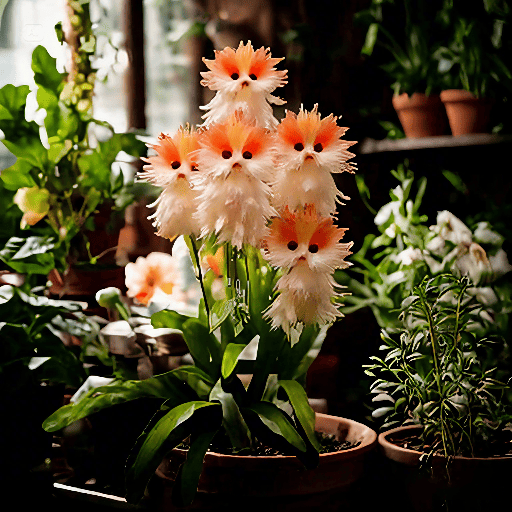
After two years of preparation, Erin and her team ventured into the mountains during the 2018 rainy season. They navigated landslide-prone gorges, battled altitude sickness, and even got lost in a storm. Finally, on a near-vertical cliff face, Erin spotted a cluster of tiny white flowers through her binoculars—each no more than 3 cm wide. The petals arched like cat ears, with deep purple spots mimicking whiskers and stamens resembling feline eyes, creating an uncanny likeness to a curled-up kitten’s face.
Scientific Naming
DNA analysis confirmed it as a new orchid species, which Erin named Cattleya felinoides (the "Cat-Faced Orchid"). Her paper in the American Journal of Botany theorized its mimicry might attract specific pollinators, though the exact mechanism remained a mystery.

Chapter 2: Genetic Breakthroughs and Cultivation Challenges
Endangered Status
Wild populations numbered fewer than 200 plants, and attempts to cultivate them failed—their seeds required a rare symbiotic fungus to germinate, with indoor survival rates below 5%. After failed tissue-culture experiments, Erin turned to genetic engineering.
The Discovery
In 2020, UC Davis researchers sequenced the orchid’s DNA, identifying a unique "petal-morphology gene cluster" absent in other orchids. Using CRISPR, they spliced these genes into hardy Cymbidium hybridum orchids. After 317 trials, they created a domesticated variant: a cold-resistant "Household Cat-Faced Orchid" that bloomed longer and needed no fungal symbiont.
Chapter 3: From Lab to Living Room
Consumer Adaptations
Partnering with horticultural firms, Erin’s team optimized the orchid for home growers:
-
Dwarfism genes limit plant height to 15–20 cm.
-
Gray-mold resistance genes reduced maintenance.
-
Anthocyanin pathway tweaks produced 12 colors, including blue, pink, and tabby-striped blooms.
Market Sensation
In 2024, Burpee Gardening released seeds globally, with 500,000 pre-orders in a single day. The hashtag #KittyBloom went viral as users posted photos comparing the flowers to real cats—the "ears" even twitched slightly in temperature changes, adding to their lifelike charm.
Scientific and Ethical Impact
-
Evolutionary biology: The orchid’s mimicry was proven to attract bumblebees, challenging traditional pollination theories.
-
Indigenous backlash: Locals protested the commercialization of their "sacred flower," prompting Erin’s team to pledge 5% of profits to Peruvian conservation.

The Legacy
Dr. Erin Carter won the 2024 World Agricultural Science Prize, and National Geographic dubbed the Cat-Faced Orchid the "Most Enchanting Botanical Discovery of the 21st Century." Once nearly extinct, this whimsical flower thrives on windowsills worldwide—a testament to how science and nature can rewrite survival.